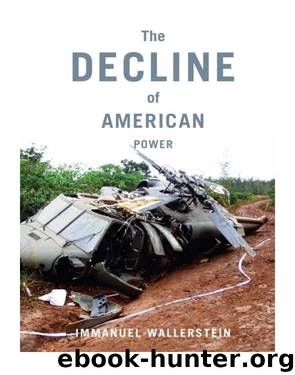
The Decline of American Power by Immanuel Wallerstein
Author:Immanuel Wallerstein
Language: eng
Format: epub
Publisher: The New Press
Published: 2011-06-02T16:00:00+00:00
DEMOCRACY AS RHETORIC
Why did the term “democracy” evolve from being the expression of revolutionary aspiration to a universal platitude? Originally, in Western political philosophy, from the Greeks through the eighteenth century, democracy had always been taken to mean what its Greek roots indicate, the rule of the people—that is, the rule of the people as opposed not only to the rule of one person but even more to the rule of the best people, the aristocracy. So democracy was first of all a quantitative concept. It implied the call for equality in a basically inegalitarian situation, since if there were “best” people, then there must have been “less good” people—ignorant, unwashed, crude, poor.
Who the best people are does not really matter. They have been defined in terms of blood/descent/formal attributions. They have been defined in terms of wealth/property/economic managerial role. They have been defined in terms of education/intelligence /complex skills. And all of these modes of classifying the best have always been accompanied by assumptions that manners /style of life/being “civilized” is a characteristic of the best people. The crucial element has always been to distinguish between two groups, those defined as having the capacity to participate in the process of collective decisions and those said to be without this capacity. Democracy as an idea, as a movement, was originally intended to refuse such a distinction as the basis of organizing political life.
There was never really any important debate on this issue; there could not have been one until the time that the concept of “citizenship” became current in ordinary political discourse. And this cultural shift is the great rhetorical legacy of the French Revolution. We are all citizens now.
Or are we? The basic discussion about the implications of the concept of citizenship took place at two successive moments in time. In the beginning of the nineteenth century, it took the form of an internal national debate in Great Britain, France, the United States, and a few other countries, centering on the issue of the suffrage.6 The basic alternative was that between suffrage of the propertied, what the French called suffrage censitaire, and universal suffrage. We know that eventually, in these countries and then elsewhere, universal suffrage won out; furthermore, what was included in the term “universal” was steadily expanded.
But once the principle of universal suffrage became accepted (even if not fully implemented), the debate shifted location. As suffrage became wider in Western countries (and other elements of civil liberties became more widespread as well in these same countries), the term “citizen” became more legitimate in these countries and was utilized to fulfill its inclusive intention. However, the concept of citizen always excludes every bit as much as it includes. For citizen necessarily implies noncitizen. If the dangerous classes are no longer dangerous, if the uncivilized working classes are now accepted as citizens, then the rhetorical line between civilized and uncivilized shifts to being one between civilized countries and uncivilized countries. This would then become the chief rhetorical justification of
Download
This site does not store any files on its server. We only index and link to content provided by other sites. Please contact the content providers to delete copyright contents if any and email us, we'll remove relevant links or contents immediately.
| Arms Control | Diplomacy |
| Security | Trades & Tariffs |
| Treaties | African |
| Asian | Australian & Oceanian |
| Canadian | Caribbean & Latin American |
| European | Middle Eastern |
| Russian & Former Soviet Union |
The Secret History by Donna Tartt(19085)
The Social Justice Warrior Handbook by Lisa De Pasquale(12190)
Thirteen Reasons Why by Jay Asher(8909)
This Is How You Lose Her by Junot Diaz(6885)
Weapons of Math Destruction by Cathy O'Neil(6279)
Zero to One by Peter Thiel(5801)
Beartown by Fredrik Backman(5751)
The Myth of the Strong Leader by Archie Brown(5507)
The Fire Next Time by James Baldwin(5442)
How Democracies Die by Steven Levitsky & Daniel Ziblatt(5218)
Promise Me, Dad by Joe Biden(5153)
Stone's Rules by Roger Stone(5087)
A Higher Loyalty: Truth, Lies, and Leadership by James Comey(4960)
100 Deadly Skills by Clint Emerson(4924)
Rise and Kill First by Ronen Bergman(4788)
Secrecy World by Jake Bernstein(4752)
The David Icke Guide to the Global Conspiracy (and how to end it) by David Icke(4717)
The Farm by Tom Rob Smith(4507)
The Doomsday Machine by Daniel Ellsberg(4490)
